- Call for a Free Consultation
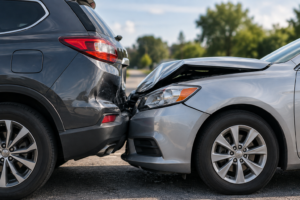
Rear-end collisions can happen in seconds. You may be stopped at a red light, slowing for traffic, or waiting to make a turn when another vehicle strikes you from behind. Although these crashes may look straightforward, determining fault and recovering fair compensation can become more complicated than expected.
At Wallentine Injury Law, we help people understand their rights after rear-end collisions and deal with insurance companies that may try to reduce what they pay. People injured in rear-end collisions may have questions about medical bills, missed work, vehicle repairs, and what comes next.
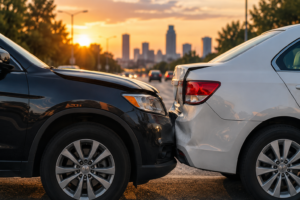
 Many rear-end collisions occur because a driver is following too closely. Not leaving enough space to stop safely is especially dangerous in heavy traffic, bad weather, or situations where vehicles must stop suddenly. A driver who follows another car too closely may have little time to react when traffic conditions change.
Other crashes happen because of distracted driving. A driver looking at a phone, adjusting controls, eating, or focusing on something outside the vehicle may not notice that traffic ahead has slowed. Speeding, fatigue, impaired driving, and poor road conditions can also contribute to rear-end collisions.
Common causes include:
Understanding the cause can be an important part of rear-end accident claims because evidence may show what each driver was doing immediately before impact.
In many rear-end collisions, attention turns to the driver who struck the vehicle ahead. Drivers generally need to maintain enough distance to react and stop safely. That is why following too closely accidents often raise questions about whether the rear driver was paying attention and maintaining a reasonable following distance.
However, being the rear driver does not automatically answer every question about responsibility. Evidence matters. Police reports, photographs, witness statements, vehicle damage, traffic-camera footage, and other records may help establish what happened. Knowing how to get a police accident report in Kansas can be useful when gathering records after a crash.
Some rear-end collisions involve actions by more than one person. For example, a driver ahead may make an unsafe maneuver, have nonworking brake lights, or suddenly enter a lane without enough space. Multi-vehicle pileups can make fault even harder to sort out.
The rules governing shared responsibility depend on where the accident occurred. In Kansas, the way fault is divided can affect whether an injured person can recover damages and how much may be available. Our team can review the facts and explain how comparative negligence may apply to rear-end accident claims.
Photos of the vehicles and crash scene, medical records, witness information, insurance documents, and police reports can all provide useful evidence. These materials may help establish how following too closely accidents happened and support an injured person’s account of the crash.
Even a crash that causes limited vehicle damage can leave someone hurting. Rear-end collisions commonly involve sudden movement of the head and neck. Whiplash can cause neck pain, stiffness, headaches, reduced movement, shoulder discomfort, and other symptoms.
Some victims may also experience back injuries, fractures, head injuries, or other conditions. Our team understands that neck injuries can affect work, sleep, driving, and everyday activities.
Seeking medical care also creates documentation connecting injuries and treatment to the accident. When pursuing whiplash injury compensation, medical records can help show the type of injury, treatment received, and continuing symptoms.
 The value of rear-end accident claims depends on the individual circumstances. Compensation may address medical expenses, lost income, pain, reduced quality of life, and other losses connected to the collision.
Insurance companies may question how badly someone was injured or whether all treatment was related to the crash. Understanding common insurance tactics can help victims see why an early settlement offer may not reflect the full impact of their injuries. Whiplash injury compensation may depend on medical evidence, recovery time, lost wages, and how the injury affects daily life.
At Wallentine Injury Law, we focus on the person behind every injury claim. Attorney Jerry “Wally” Wallentine has spent 19 years practicing law and has represented more than 1,000 clients.
Our firm has recovered millions of dollars for injured clients, including several individual seven-figure results. We believe clients deserve regular communication, truthful guidance, and representation centered on their individual needs. Our team understands how insurance companies may try to minimize injuries and reduce payments after rear-end collisions. We work to pursue whiplash injury compensation and other damages supported by each client’s circumstances. Free consultations give you an opportunity to discuss what happened and learn about your options.
Call us if you need help protecting your interests after a crash. Contact our team today at 913-934-6333 to get started.

Jerry and Christal were outstanding from start to finish. They guided me through every step of the process, communicated clearly, and fought hard to make sure I received a fair settlement. I always felt supported and informed, and the outcome exceeded my expectations. I couldn’t have asked for better representation.
I would like to thank Wallentine Injury Law. Cody and Trish were the best. I even had a chance to meet Jerry. We talked all the time, they kept me updated and got me the most, and I would definitely go back if I had another accident. I wasn’t just
I had a great experience with this law office from start to finish. The staff was professional, responsive, and genuinely cared about my case. My attorney took the time to explain everything clearly and kept me updated throughout the entire process. I always felt heard and supported. I highly recommend
Hip hip HOORAY for Sarah B!!! I have nothing but fabulous things to say about Sarah and this firm!!! From the very first visit, I could tell that this firm and the wonderful Sarah had my back. They kept me informed of everything, and it was always my choice to
CJ Dimarco recently assisted me with a legal matter that had not only taken a financial and physical toll on me, but also a mental toll, and I genuinely don’t know how I could have even began to think about getting through it without his professional guidance along the way.
This is the best injury law firm anybody can go to. Throughout my four years, in my case, they have been the utmost respectful and kind to me. They always make sure to communicate with me and take care of all my needs. I would recommend Jerry to anybody who’s
Amazing firm! Awesome with results and very ethical with all they do. It’s very nice to find somebody with such integrity.
CJ and Angela were an absolute pleasure to work with! They ensured our involvement in the whole process was very minimal and they were able to produce the results we were hoping for! CJ was professional and transparent and did an excellent job of getting us our settlement. Angela did
It is rare to find such an excellent team of competent and compassionate people in any business. To find them in a law firm is an extremely pleasant surprise. In addition to being a great lawyer, Jerry is also really good at hiring and empowering great people.
Sarah and Cody are an awesome team. Listened to me when I had concerns and brought a fantastic final settlement.
Outstanding legal services. He pays close attention to your needs, gives excellent advice, and manages your issues with you. Highly recommend using his services.
Jerry Wallentine, Angela Oswald, and their staff represented us in a serious truck accident. Not only did they work tirelessly to get us covered in a fair and equitable manner, but they were always friendly, personable, and of the highest moral character. We can most highly recommend them in every
They were very professional and caring. They heard our story and what we were there for, and immediately wanted to help, answered any questions I had at any time. Christal was amazing, and I appreciate everything she did to help my family.
My husband was in a pretty bad accident where another driver ran a red light. I was (thankfully) able to obtain video footage from the city traffic cams, and we reached out to Jerry. From the onset of our working relationship, Jerry and his team were very good communicators. We've
Jerry is top notch!!! I called Wallentine Injury Law LLC, after being turned away by two other attorneys. A diligent and thorough professional, Jerry reviewed my case with an open mind. He read between the lines and devised a creative strategy which resulted in a HUGE win! I highly recommend
Jerry represented me on a complex Johnson County District Court case that was very complicated. He had an excellent grasp of the facts and the law and fought hard for me. The result was better than I expected!
I am so grateful to have worked with Jerry and Sarah on my personal injury case I can’t thank them enough for everything they did for me throughout my case, they consistently listened to my concerns and ensured that I felt heard and understood. Their prompt responses and clear communication
This group was fantastic to work with! I got in a wreck and my insurance company, the person who caused the wreck, and his insurance company, did me so wrong. They helped me get justice and A pretty nice settlement. Ashley was AMAZING! with being transparent and contacting me, making
I had 2 cases and the Martin & Wallentine law firm took great care of me and my needs. The communication was great , especially with Christal constantly updating me. I would recommend them to my friends and family and I wish them all the best in the future
I wanted to take a moment to express my heartfelt gratitude for Jerry Wallentine and his team's exceptional legal guidance and unwavering support throughout my case. Their expertise and dedication have made a significant impact, and I am truly thankful for their assistance in helping me.
I am extremely happy with everything Martin & Wallentine has done for me. If I ever need anything in the future they will be my first choice. Especially love Christal. Always kept me updated on what was happening all the time and very friendly.
I contacted Martin & Wallentine about helping me with getting a quite title for a vehicle that I purchased out of state. And they where very helpful and walked me through the process and after speaking with them we proceeded and it was great they keep me updated with the